


Sun, Sweat & Shirts: Answering Those Hot Summer Questions



Sun, Sweat & Shirts
Answering Those Hot Summer Questions
When summer arrives in Texas, apparel suddenly matters a whole lot more.
Why does one shirt feel cool and comfortable while another feels like a portable sauna?
What exactly does “moisture-wicking” mean?
Do UPF-rated shirts really block the sun?
And why does your black t-shirt feel ten degrees hotter than the white one hanging next to it?
This week we’re breaking down the science behind summer apparel.
Why Cotton Feels Different in Summer
Cotton is one of the most popular fabrics in the world for a reason.
It’s:
- Soft
- Breathable
- Comfortable
- Natural
Cotton fibers allow air to circulate easily, which helps your body release heat.
However, cotton also acts like a sponge.
When you sweat:
- Cotton absorbs moisture
- Holds moisture against the body
- Takes longer to dry
That’s why a cotton shirt can feel amazing in dry weather but heavy and damp during a humid Texas afternoon.
How Moisture-Wicking Fabrics Actually Work
Your body naturally cools itself by sweating.
The problem isn’t the sweat itself.
The problem is what happens after the sweat leaves your skin.
Traditional fabrics like cotton absorb moisture and hold onto it, which can leave the garment feeling:
- Heavy
- Damp
- Sticky
- Hot
Moisture-wicking fabrics are engineered differently.
Instead of soaking up sweat like a towel, they’re designed to move moisture through the fabric as quickly as possible.
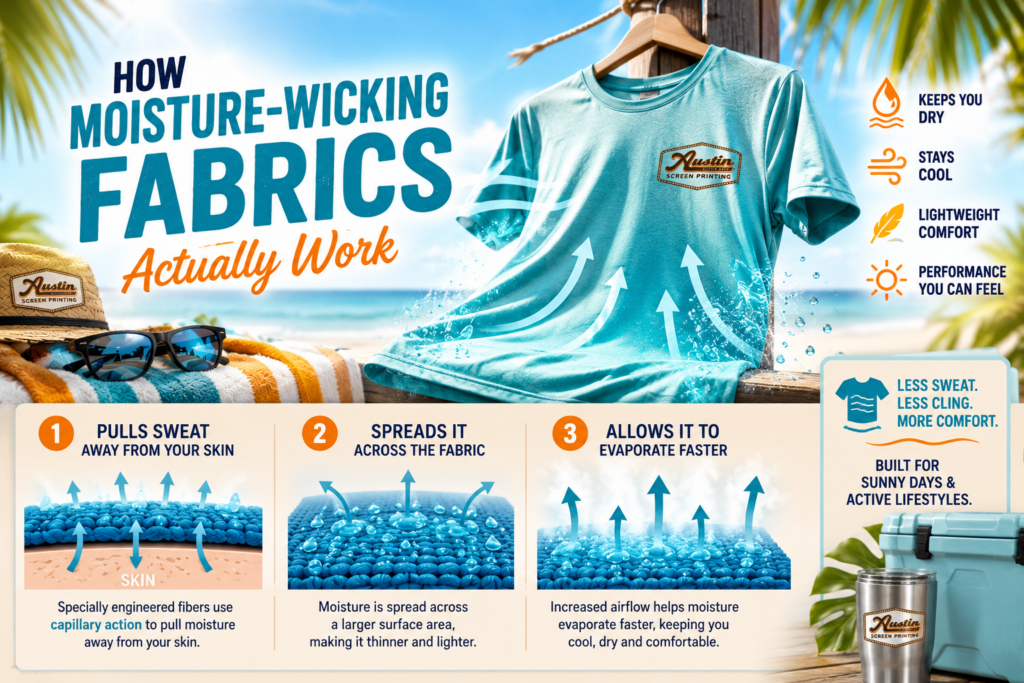
Step 1: Pull Sweat Away From Your Skin
Performance fabrics use specially engineered synthetic fibers — usually polyester blends — with very smooth surfaces and microscopic channels built into the fibers.
These fibers create what’s called:
“Capillary Action”
The fabric literally pulls moisture away from your skin and toward the outer surface of the garment.
Think of how water travels up a paper towel.
The moisture is being “transported” through the fabric rather than absorbed into it.
This helps prevent that soaked, clingy feeling against your body.
Step 2: Spread Moisture Across the Fabric Surface
Once the sweat reaches the outer layer of the shirt, the fabric spreads it out across a larger surface area.
Instead of sweat collecting in one wet spot:
- The moisture disperses
- The sweat layer becomes thinner
- More of the garment surface is exposed to air
This is extremely important because evaporation works faster over larger surface areas.
Step 3: Allow It to Evaporate Faster
Now that the moisture is spread thinly across the outer surface, airflow and heat can evaporate it much more quickly.
As the sweat evaporates:
- Heat leaves your body
- The fabric dries faster
- The shirt stays lighter and cooler
What Does UPF-Rated Apparel Mean?
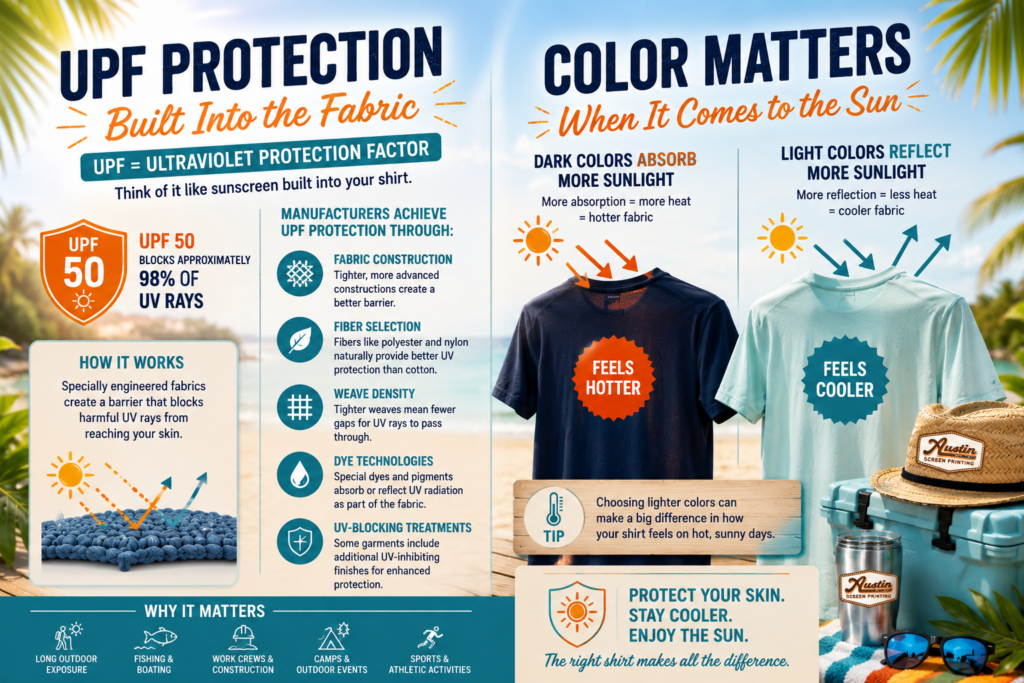
UPF stands for:
Ultraviolet Protection Factor
Think of sunlight like water trying to pass through a screen door.
The tighter and more engineered the “screen,” the less sunlight gets through.
Manufacturers achieve UPF protection through several factors:
Fabric Construction
The way a fabric is built has a huge impact on UV protection.
Some fabrics naturally create a tighter barrier between the sun and your skin.
For example:
A lightweight cotton t-shirt may have tiny spaces between fibers that allow UV rays to penetrate.
A technical performance shirt may be constructed specifically to minimize those openings.
Even if two shirts weigh the same, the one with a more advanced construction can provide significantly better sun protection.
Weave Density
This is one of the biggest factors.
The tighter the weave or knit, the fewer gaps exist for sunlight to pass through.
Imagine holding two fabrics up to a window:
Loose Weave
You can see light passing through easily.
More UV rays can reach your skin.
Dense Weave
Less visible light passes through.
Less UV radiation reaches your skin.
This is why many UPF-rated garments feel lightweight while still providing excellent protection.
Manufacturers engineer the fabric structure to maximize coverage without making the garment feel heavy.
Why Dark Shirts Feel Hotter
Ever wonder why black shirts seem so much hotter?
The answer is simple.
Dark colors absorb more sunlight.
Light colors reflect more sunlight.
When sunlight hits a black shirt:
- More solar energy is absorbed
- The fabric heats up faster
- The shirt feels warmer
Lighter colors:
- Reflect more sunlight
- Stay cooler longer
- Often feel more comfortable in direct sun
- Dye Technologies
Color plays a bigger role than many people realize.
But modern dye technologies go beyond simple color.
Many manufacturers use specialized pigments and dye systems that help absorb or scatter UV radiation.
These dyes become part of the fabric itself and contribute to the garment’s overall UPF rating.
This allows manufacturers to create:
- Light-colored shirts
- Bright fishing shirts
- Pastel performance apparel
- while still maintaining strong UV protection.
Tips for Summer Camps & Outdoor Events
When selecting apparel for outdoor programs, comfort often matters more than people realize.
Consider Performance Fabrics For:
- Sports camps
- Outdoor staff
- Event volunteers
- Field crews
Consider Cotton or CVC Blends For:
- Casual events
- Family reunions
- Festival merchandise
- Retail-style apparel
- Consider UPF Apparel For:
- Long outdoor exposure
- Coaches
- Counselors
- Construction teams
- Summer staff
Don’t Forget Color Selection
Sometimes simply choosing a lighter garment color can dramatically improve comfort throughout the day.

Planning a Summer Event?
The best shirt is the one people actually want to wear.
That’s why we spend time helping customers select the right garment—not just the cheapest one.
- Fill out this form to start a conversation
- Call us to walk through the options 512-454-6249
- Stop by the shop in person 8613 Cross Park Dr. Austin, TX 78754
Austin Screen Printing & Austin Embroidery
Proudly serving Austin since 1975
Thoughtful apparel. Built for real life.