Not All Transfers Are Created Equal
Why today’s DTF printing is changing the way we decorate apparel.
If you’ve been around custom apparel for a while, you probably remember the old “iron-on” transfers. They often felt thick, stiff, and plastic-like, making them less than ideal for everyday wear.
Thankfully, Direct-to-Film (DTF) printing has come a long way.
Modern DTF technology can produce vibrant color, incredible detail, and surprisingly soft prints that hold up exceptionally well over time. It’s become an excellent option for smaller quantities, highly detailed artwork, and projects that simply aren’t the best fit for traditional screen printing.
But here’s something many people don’t realize…
Not all DTF transfers are created equal.
Just like screen printing or embroidery, the final result depends on much more than the equipment alone.
It Starts with the Artwork
One of the biggest advantages we’ve had in bringing DTF production in-house is something we’ve been doing for years—preparing artwork.
Long before DTF became popular, our art department specialized in creating color separations and simulated process artwork for complex screen printing projects. That experience taught us how ink interacts with fabric, how gradients reproduce, and how subtle adjustments can dramatically improve the finished product.
Those same principles now apply to DTF.
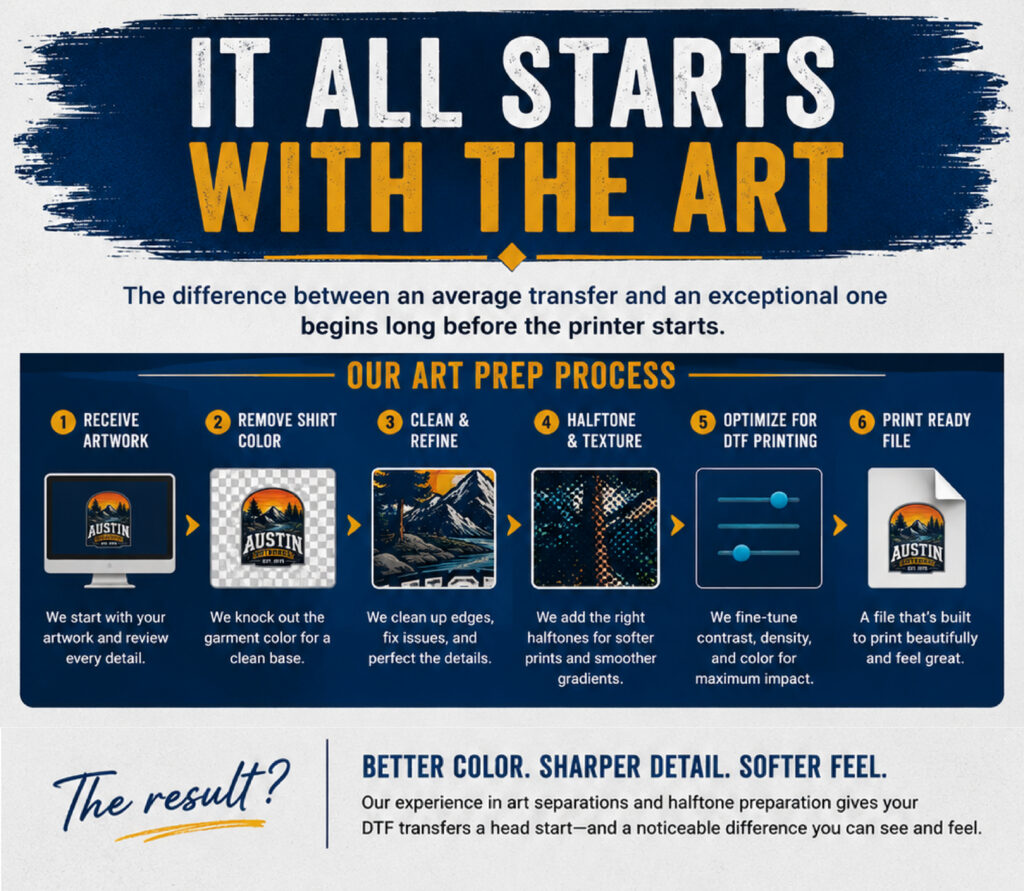
Before artwork ever reaches the printer, we carefully prepare every file by:
- Knocking out the garment color from the artwork
- Cleaning up edges and fine details
- Building smooth halftone transitions
- Optimizing gradients and transparency
- Texturing large solid areas for a softer feel
- Fine-tuning artwork specifically for DTF production
These are small details, but together they make a noticeable difference in both appearance and feel.
Many files can technically be printed.
Our goal is to make sure they’re printed well.
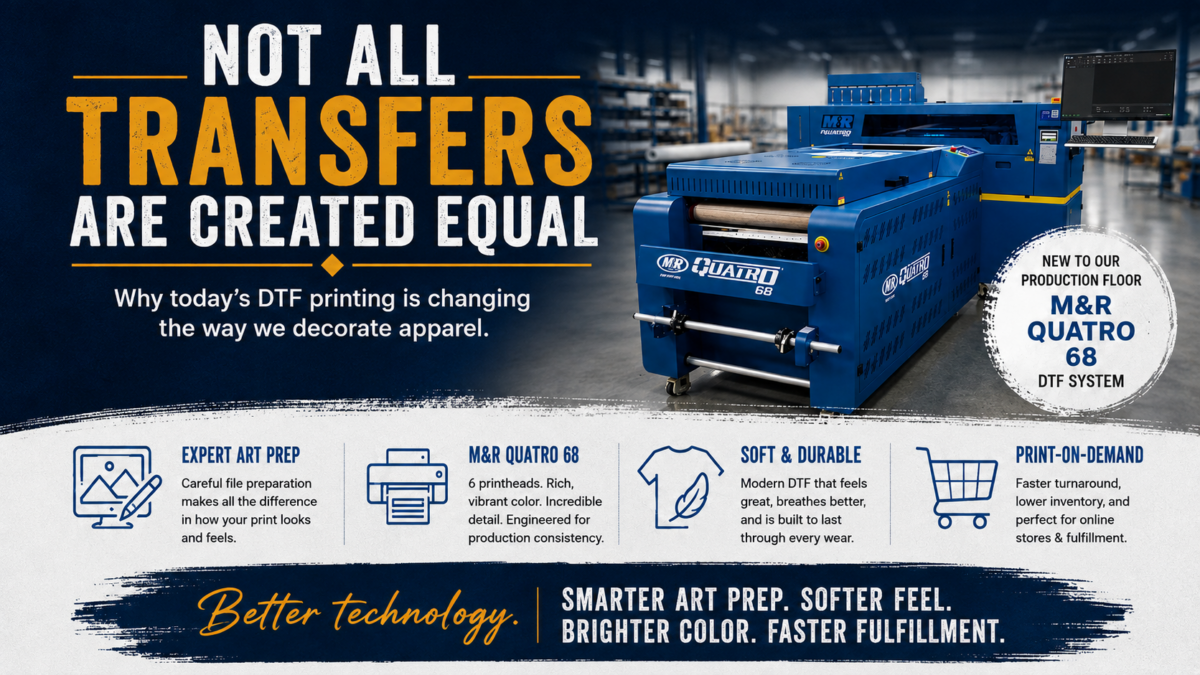
Why We Chose the M&R QUATRO 68
When it came time to add DTF to our production floor, we wanted equipment that reflected the same quality standards we’ve built our company around for nearly 50 years.
That’s why we chose the M&R QUATRO 68.
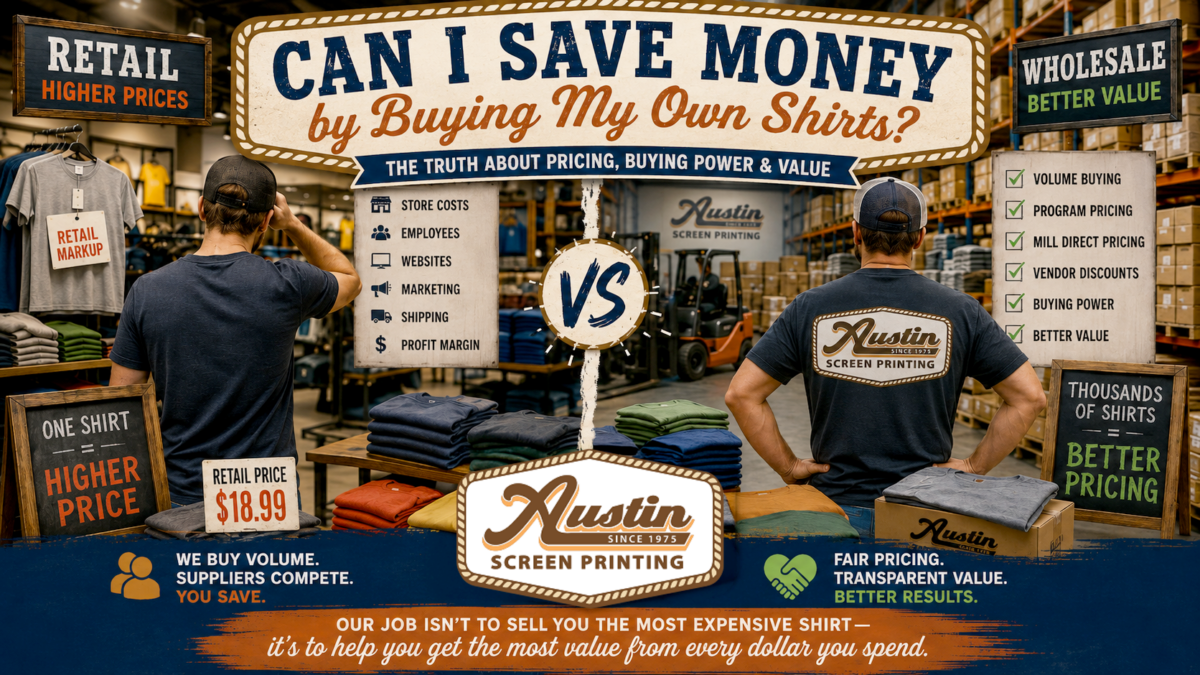
With six Epson PrecisionCore® printheads, dedicated ink channels, and an engineered print system designed specifically for production consistency, it delivers incredibly rich color, smooth gradients, crisp detail, and outstanding repeatability from one order to the next.
Combined with premium transfer films, adhesives, and inks designed to work together as a complete system, we’re able to produce transfers that look vibrant while maintaining excellent durability and a surprisingly soft feel.
Like any professional piece of equipment, though, it’s still just a tool.
The real difference comes from the people operating it—and the process behind every print.
Softer Than You Might Expect
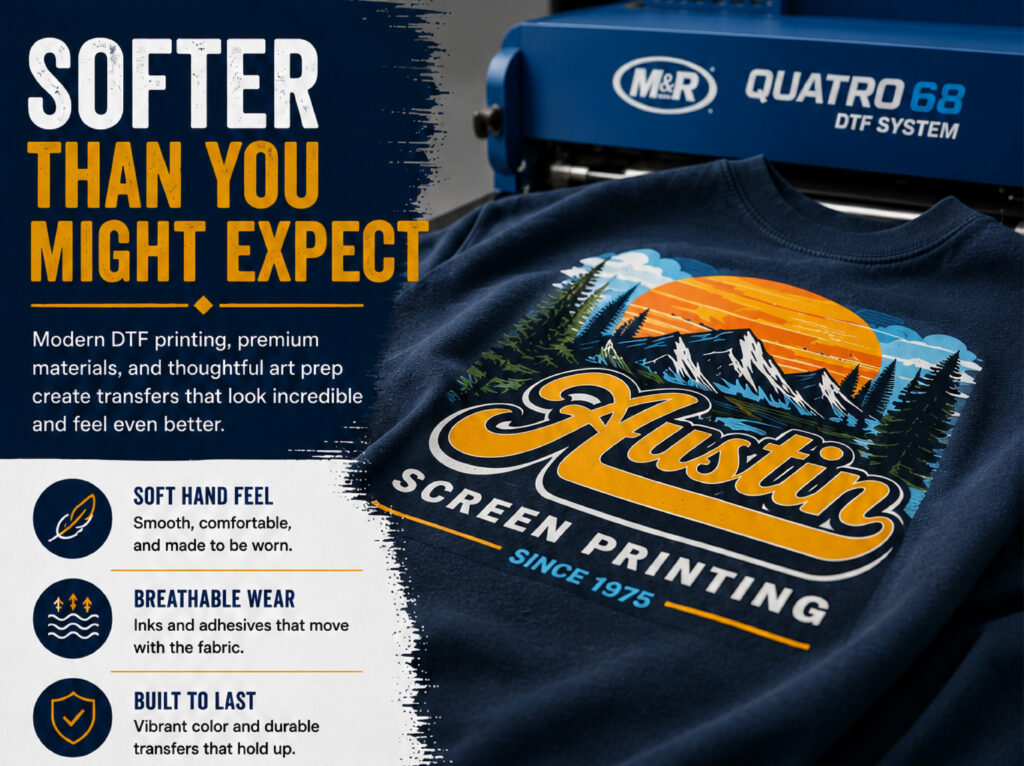
One of the biggest surprises for customers seeing modern DTF for the first time is how soft it feels.
Today’s materials, combined with proper artwork preparation and thoughtful printing techniques, create transfers that are dramatically different from the heavy, plastic-feeling transfers many people remember from years ago.
Our goal isn’t simply vibrant color.
It’s creating apparel that’s comfortable enough that you’ll actually want to wear.
It looks great AND feels great.
More Than Better Prints—A Better Way to Manage Merchandise
One of the most exciting things about bringing DTF production in-house isn’t just the print quality—it’s the flexibility it gives our customers.
For years, creating an online store or offering custom merchandise often meant ordering larger quantities up front, trying to predict what sizes would sell, and storing inventory until it was needed.
Today’s DTF technology changes that.
Because high-quality transfers can be produced quickly and efficiently, we’re able to offer faster print-on-demand production for many products. That means merchandise can often be printed as orders come in, reducing excess inventory while still delivering professional-quality apparel.
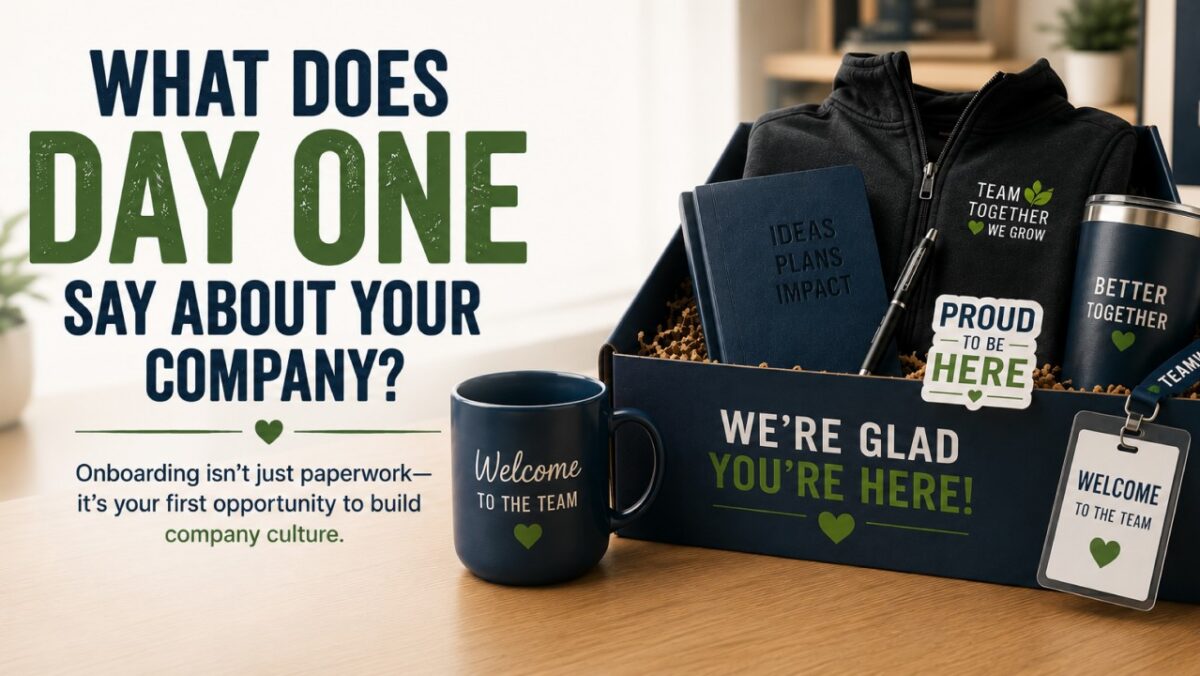
For businesses, schools, nonprofits, artists, and promotional programs, that opens the door to:
- Company stores with lower inventory requirements
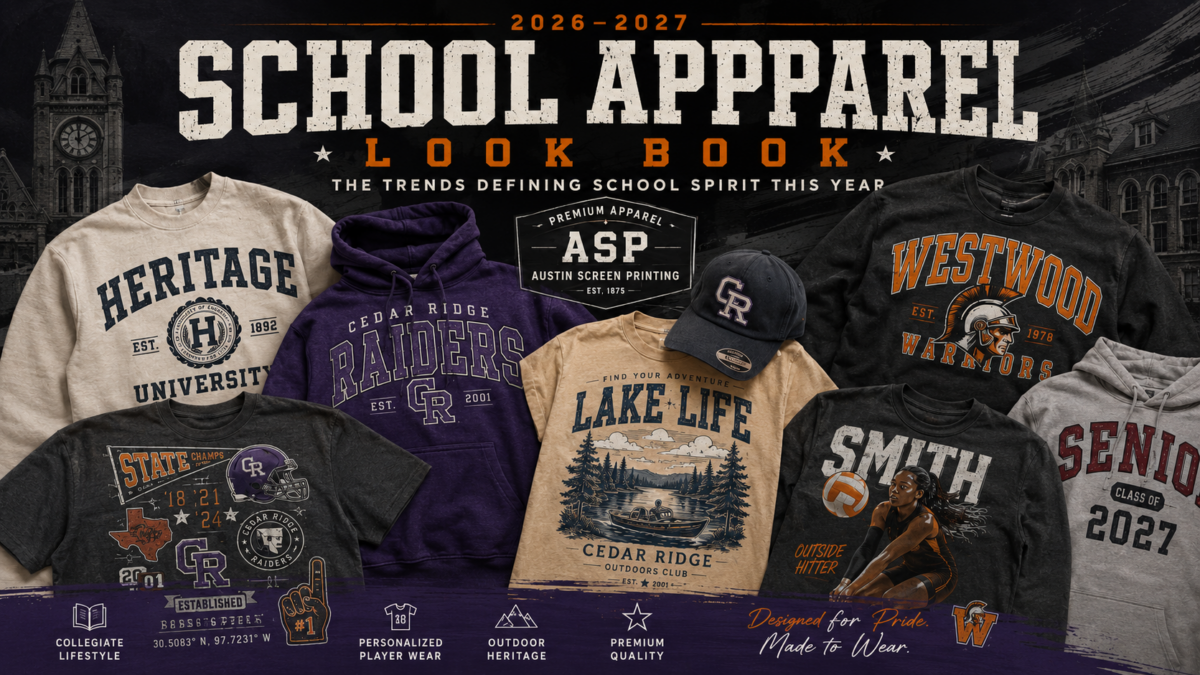
- School spirit wear programs that can stay open year-round
- Fundraising campaigns without large upfront commitments
- Artist and band merchandise produced as orders are placed
- Easier replenishment of popular designs without waiting for another large production run
- Faster fulfillment for one-off orders and personalized apparel
It doesn’t replace traditional bulk production—in many cases, screen printing is still the most economical solution for larger quantities.
Instead, it gives us another tool that allows us to recommend the right production method for each project.
Sometimes ordering 500 shirts makes perfect sense.
Sometimes ordering one at a time makes even more sense.
Having both capabilities allows us to meet customers where they are.
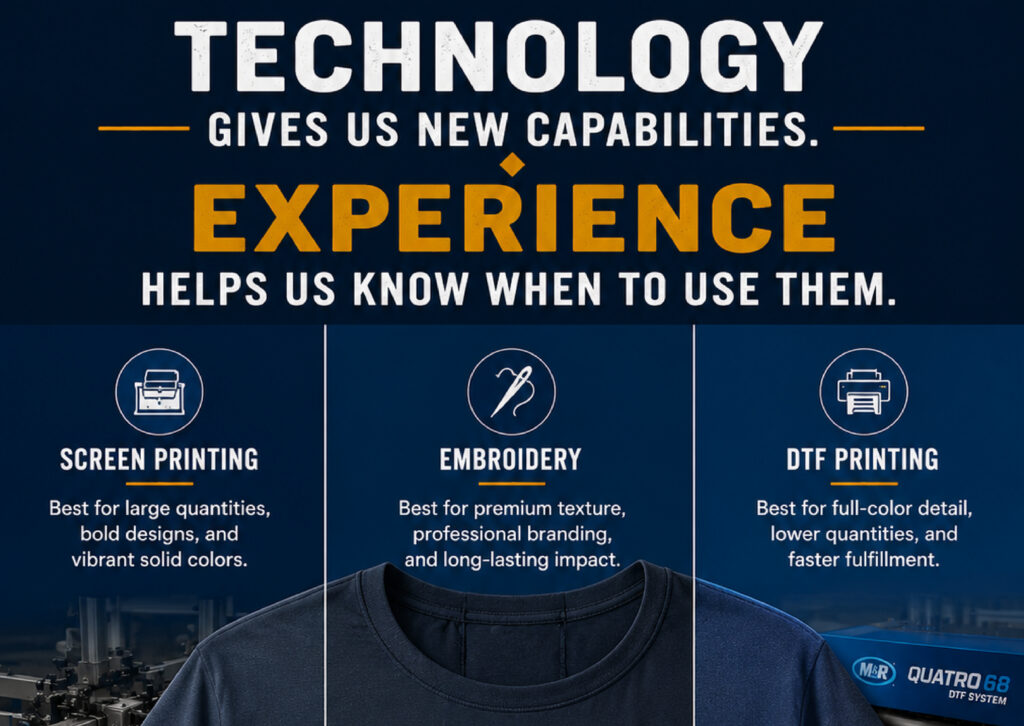
Technology gives us new capabilities. Experience helps us know when to use them.
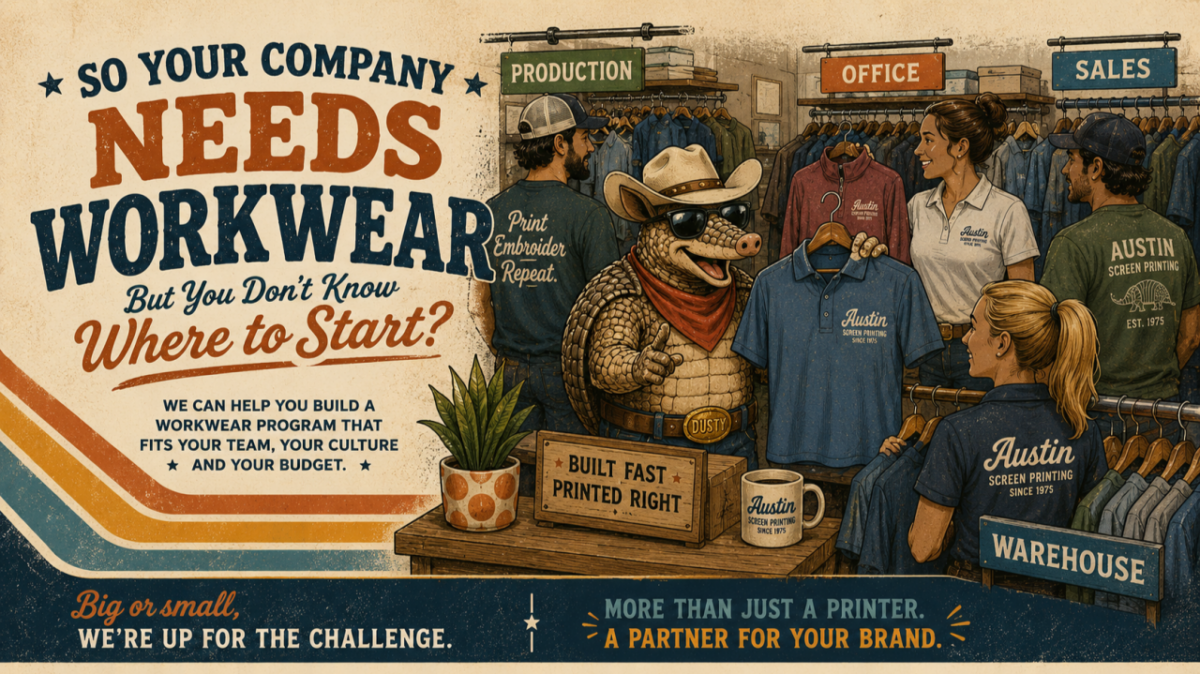
Whether your project is best suited for screen printing, embroidery, or DTF, our goal remains the same: helping you choose the process that delivers the best finished product—not simply the easiest one to produce.
Quality first. Honest advice. The right process for the right project.
If you’d like to learn more about our new DTF capabilities—or discuss whether it’s the right fit for your next project—we’d love to help.
Austin Screen Printing & Austin Embroidery
Proudly serving Austin since 1975
Helping customers make informed apparel decisions for 50 years.