

The Sitch Behind the Stitch | What Every Customer Should Know About Embroidery

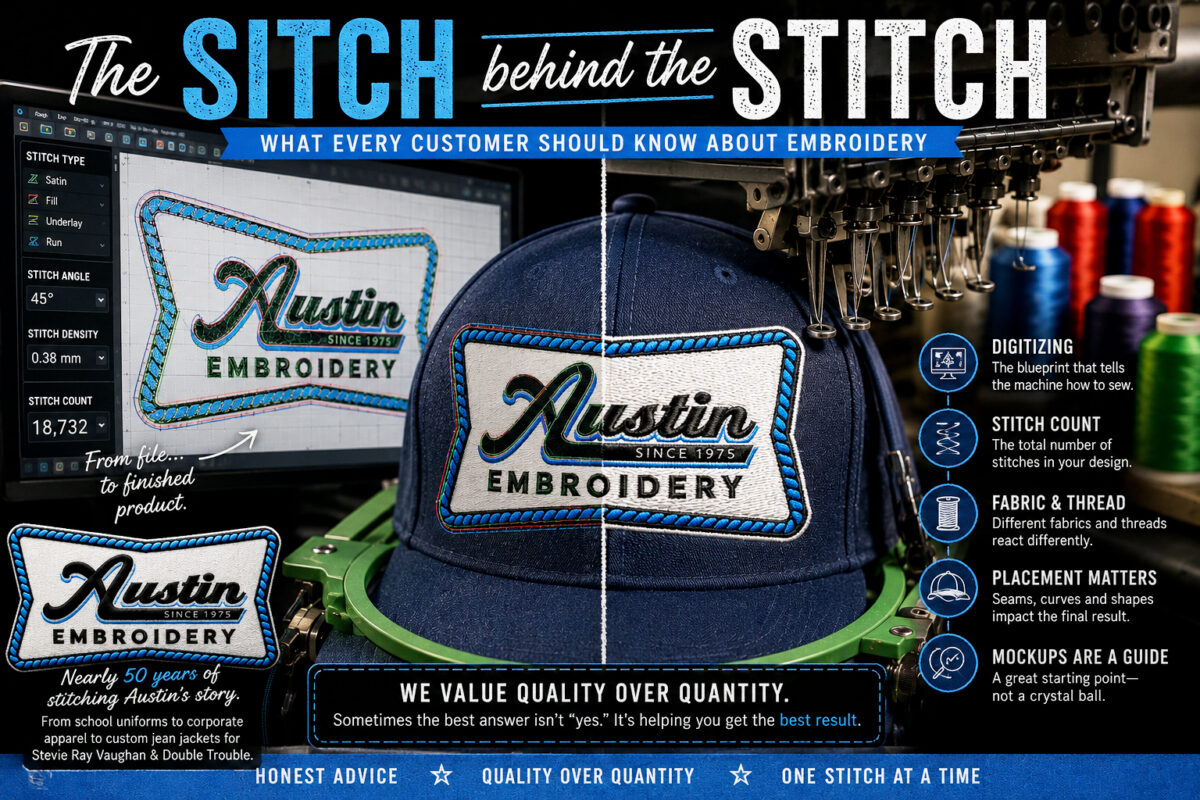
What Every Customer Should Know About Embroidery
Embroidery is everywhere right now.
From oversized collegiate sweatshirts and vintage-inspired hats to premium workwear and corporate apparel, embroidery has become one of the biggest trends in custom decoration.
But unlike screen printing, embroidery isn’t simply placing artwork on a garment.
Every logo has to be carefully engineered—one stitch at a time.
This week, we’re pulling back the curtain on how professional embroidery really works and sharing a few things most shops never tell you.
It All Starts With Digitizing
Before an embroidery machine can sew your logo, it must first be digitized.
Digitizing isn’t converting a file format—it’s creating a blueprint that tells the machine:
- Which stitch types to use
- Stitch direction (angle)
- Stitch density
- Sewing order
- How the design will react on the garment
Two shops can embroider the exact same logo and produce very different results simply because the embroidery files were created differently.
A Few Embroidery Terms You’ll Hear
Stitch Count
The total number of stitches in your design. More stitches don’t always mean better embroidery—good digitizing uses only what’s needed for a clean result.
Satin Stitch
These smooth, raised stitches are typically used for lettering, borders, and fine details. They create the polished look most people associate with premium embroidery.
Fill Stitch
Large areas of color are created with thousands of closely spaced stitches called fill stitches. Changing the stitch direction helps add texture, dimension, and visual interest.
Stitch Angle
Even subtle changes in stitch direction affect how light reflects off the thread, creating depth and helping different sections of the design stand apart.
Things Most Embroidery Shops Won’t Tell You
Our job isn’t simply to say “yes.”
Our job is to help your embroidery look its absolute best.
Sometimes that means recommending a different approach than what was originally requested.
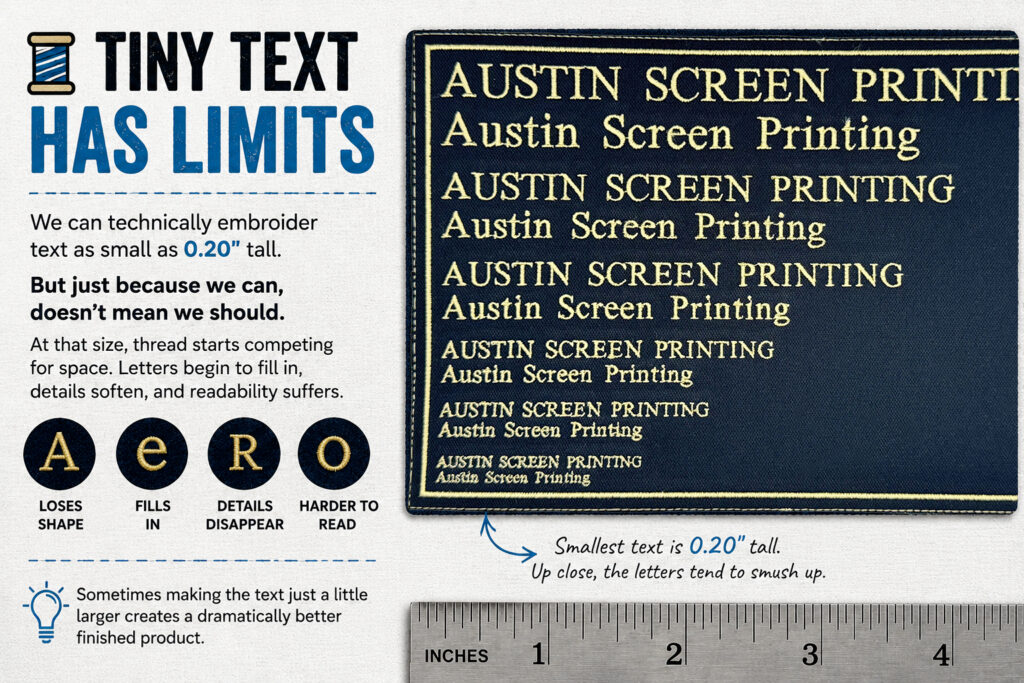
Tiny Text Has Limits
We can technically embroider text as small as 0.20″ tall.
But just because we can doesn’t always mean we should.
At that size, letters begin to fill in, details soften, and readability suffers.
Sometimes making the text just a little larger creates a dramatically better finished product.
Hat Fronts Are Smaller Than You Think
Most standard caps measure nearly 5 inches wide, but you only have about 2½ inches of usable embroidery height on the front.
That’s why some logos simply can’t be scaled proportionally without compromising the design.
Sometimes a small adjustment to the artwork results in a much cleaner-looking hat.
Every Garment Behaves Differently
A logo that looks great on a jacket may need adjustments before it’s sewn onto a performance polo or a structured cap.
Fabric stretches.
Seams get in the way.
Thread pulls.
Embroidery reacts differently depending on what it’s sewn on—and that’s completely normal.
Mockups Are a Great Starting Point
Digital mockups are excellent for reviewing placement, size, and garment color.
But embroidery is created with real thread on real fabric.
Thread has thickness.
Fabric moves.
Needles create tension.
That’s why a mockup should be viewed as a guide—not an exact preview of the finished embroidery.

Why We Sometimes Recommend Changes
If we suggest:
✔ Making text slightly larger
✔ Simplifying fine details
✔ Choosing a different font
✔ Adjusting placement
it’s never about making our job easier.
It’s because we want your embroidery to sew cleaner, last longer, and represent your brand as professionally as possible.
Sometimes the best advice isn’t simply saying “yes”—it’s helping you make a design choice that produces a better result.
Every Stitch Represents Your Brand
At Austin Embroidery, our goal isn’t to see how much detail we can squeeze into a logo.
It’s to create embroidery that looks great from across the room, wears well for years, and represents your brand the way it deserves to be represented.
Sometimes that means recommending a slightly larger font.
Sometimes it means simplifying a detail.
Sometimes it means saying, “There’s a better way.”
Because we’d rather have an honest conversation upfront than deliver something that doesn’t meet your expectations.
Tips for Better Embroidery
- Choose bold, readable fonts whenever possible.
- Avoid extremely fine lines and tiny details.
- Let the garment help determine the logo size.
- Trust the digitizing process—it exists for a reason.
- Ask questions early. Small changes before production often make a huge difference.
Have an Embroidery Project Coming Up?
Whether you’re decorating polos, hats, jackets, or retail merchandise, we’re happy to review your artwork and help you create embroidery that looks its best. Know you know the sitch behind the stitch.
- Fill out this form to start a conversation
- Call us to walk through the options 512-454-6249
- Stop by the shop in person 8613 Cross Park Dr. Austin, TX 78754
Austin Screen Printing & Austin Embroidery
Proudly serving Austin since 1975
Thoughtful embroidery. Honest advice. One stitch at a time.